
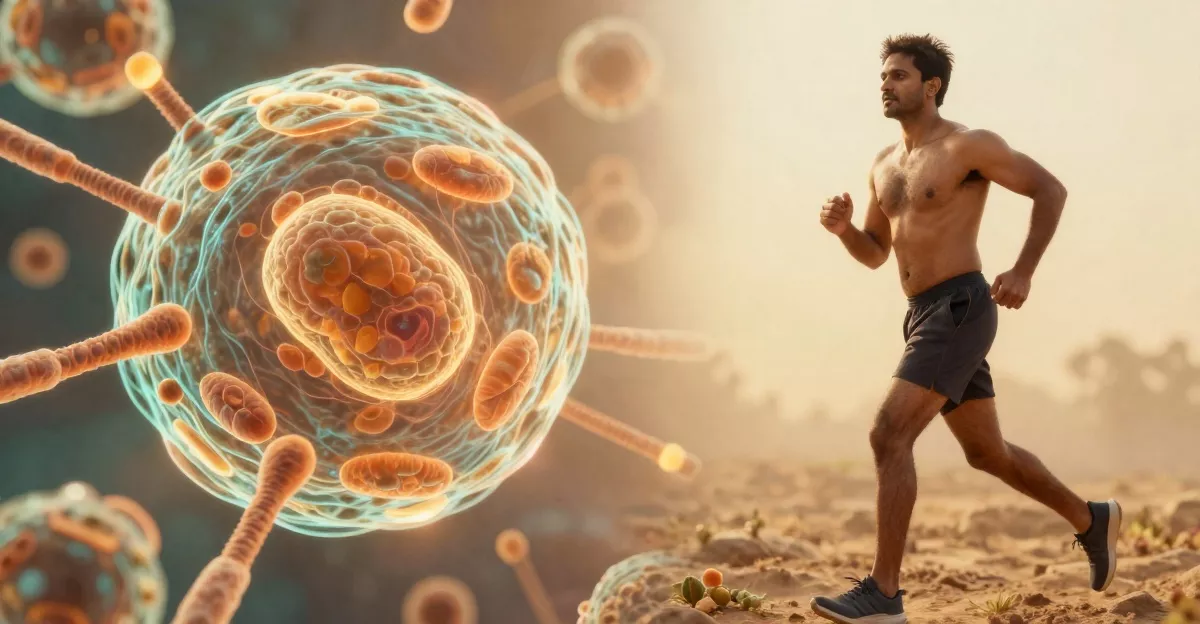
Most people think of aging as something that happens to the outside of the body - the grey hair, the slower recovery, the creaking knees that were not there a decade ago. These are the visible symptoms. But they are not the cause.
Aging begins at a scale far below what any mirror can reveal. It begins in the cell - in the microscopic machinery of DNA replication, energy production, protein maintenance, and cellular communication that keeps every organ, tissue, and system in the body functioning. Long before a single visible sign of aging appears, the biological processes that drive it have been underway for years, quietly accumulating changes that eventually manifest as the external aging we recognize and dread.
The extraordinary development of the last three decades is this: science has identified not just that these processes occur, but specifically which processes they are, exactly how they work, and - most importantly - how they can be influenced. The field has a name for them: the Hallmarks of Aging. Understanding them is not an academic exercise. It is the foundation of every intelligent, evidence-based approach to living longer and better.
The Hallmarks Framework: A Map of Cellular Aging
In 2013, molecular biologist Carlos López-Otín and colleagues published what became one of the most cited papers in the history of biology - a landmark review in the journal Cell identifying nine fundamental biological processes that collectively drive organismal aging. In 2023, the same team updated and expanded the framework to twelve hallmarks of aging, adding chronic inflammation, disabled macroautophagy, and dysbiosis to the original nine - reflecting a decade of accelerating research.
The framework's power lies in its actionability. According to the American Federation for Aging Research (AFAR), each hallmark fulfills three criteria: it increases with age, experimentally amplifying it accelerates aging, and therapeutically targeting it decelerates aging. This means each hallmark is not simply a description of what goes wrong - it is a potential intervention target.
This article focuses on four of the most clinically significant hallmarks: telomere attrition, mitochondrial dysfunction, cellular senescence, and epigenetic alterations - and what you can practically do about each one.
Deep Dive
To dive deeper into this topic, read our comprehensive guide: The Complete Guide to Longevity, Healthspan & Anti-Aging
Hallmark 1: Telomere Attrition - The Biological Clock in Every Cell
Picture a shoelace. At each end sits a small plastic cap - the aglet - that prevents the lace from fraying. Remove the aglets, and the shoelace begins to unravel from both ends. Telomeres are the biological equivalent of those caps - repetitive DNA sequences (TTAGGG, repeated thousands of times) that protect the ends of every chromosome in every cell.
The problem is structural and unavoidable in normal cell division: each time a cell divides, the enzyme responsible for copying DNA cannot fully replicate the very ends of the chromosome. As a result, telomeres shorten with each cell division - losing 50-200 base pairs per replication cycle. When telomeres reach a critically short length, the cell can no longer divide safely. It enters either senescence (a dysfunctional, inflammatory zombie state - covered below) or apoptosis (programmed death). This limit on cellular replication is called the Hayflick limit, first described by Leonard Hayflick in 1961 and now understood as a core mechanism of tissue aging.
Recent research published in 2025 in LIDSEN Geriatrics confirmed that telomere shortening is not only a marker of replicative aging but also accumulates in non-dividing cells through oxidative damage - meaning even cells that rarely divide, like neurons and cardiac muscle cells, accumulate telomeric damage over time. The downstream consequence is the same: SASP (Senescence-Associated Secretory Phenotype), inflammation, and impaired tissue function.
The lifestyle levers for telomere preservation:
The most remarkable finding from telomere research - pioneered by Nobel laureate Elizabeth Blackburn and her collaborator Elissa Epel at UCSF - is that lifestyle factors powerfully modulate telomere attrition rate. Telomere length is not a fixed genetic destiny.
- Aerobic exercise is the most consistently supported intervention for telomere preservation across multiple population studies - regular runners and cyclists show telomeres equivalent to people a decade younger
- Omega-3 fatty acid supplementation (2.5g daily EPA+DHA) was shown in a 5-year randomized controlled trial to reduce telomere shortening compared to placebo - one of the few supplements with direct telomere-length evidence
- Chronic psychological stress is one of the most powerful telomere accelerators - Blackburn's caregiver studies showed telomeres equivalent to 9-17 additional years of biological aging in high-stress individuals
- Mindfulness meditation measurably increases telomerase activity - the enzyme that can restore telomere length - even after relatively short interventions of 3-4 weeks
Hallmark 2: Mitochondrial Dysfunction - The Energy Crisis of Aging

Every cell in your body - with the exception of red blood cells - contains between 100 and 2,500 mitochondria, depending on the cell's energy demands. These organelles are the cell's power plants: through a process called oxidative phosphorylation, they convert glucose and oxygen into ATP (adenosine triphosphate) - the universal energy currency that powers every biological process from muscle contraction to DNA repair.
As mitochondria age and accumulate damage, two things happen simultaneously and catastrophically: they produce less ATP (driving the fatigue, cognitive fog, and metabolic slowdown of aging) while generating more reactive oxygen species (ROS) - the free radicals that damage DNA, proteins, and the mitochondrial membrane itself. This creates a vicious cycle: mitochondrial damage generates oxidative stress, which damages mitochondria further, reducing energy output further, impairing the cell's capacity to repair itself.
Central to this process is NAD+ (nicotinamide adenine dinucleotide) - a coenzyme essential for the electron transport chain and for activating sirtuins, the longevity-regulating proteins that govern mitochondrial biogenesis, DNA repair, and metabolic efficiency. As reviewed extensively by Fight Aging's analysis of NAD+ therapies, NAD+ levels decline by approximately 50% between ages 40 and 60 - directly reducing sirtuin activity and driving mitochondrial deterioration across every organ system.
What restores mitochondrial function:
- Exercise - specifically Zone 2 cardio - is the most potent stimulus for mitochondrial biogenesis (the creation of new mitochondria) through activation of PGC-1α, the master regulator of mitochondrial metabolism. Nothing in the supplement stack matches the magnitude of this effect.
- Intermittent fasting and caloric restriction activate AMPK and suppress mTOR - shifting cells from growth mode into repair and recycling mode, triggering mitophagy (the targeted removal of damaged mitochondria) and stimulating the production of healthier replacements
- Cold exposure (cold showers, ice baths) activates brown adipose tissue and increases mitochondrial density through thermogenic adaptation
- NMN and NR supplementation raise cellular NAD+ levels in human clinical trials - with particular evidence for muscle insulin sensitivity and vascular function in aging adults, though long-term outcome data remains under active investigation
- Sauna use (4-7 sessions per week at 80-100°C) activates heat shock proteins that protect mitochondrial proteins from oxidative damage - with Laukkanen's Finnish cohort studies showing 40% all-cause mortality reduction in regular sauna users
Hallmark 3: Cellular Senescence - The Zombie Cell Problem
Perhaps the most vivid concept in the entire hallmarks framework is cellular senescence - a state in which a cell, having accumulated damage beyond its repair capacity, stops dividing but stubbornly refuses to die.
These senescent cells - informally called "zombie cells" in scientific literature - are not simply inert. They actively secrete a toxic mixture of inflammatory molecules, proteases, and growth factors collectively called the SASP (Senescence-Associated Secretory Phenotype). This SASP output poisons neighboring cells, promotes chronic low-grade inflammation (inflammaging), degrades surrounding tissue, and paradoxically creates the conditions that drive additional cells into senescence - a cascading process that accelerates with age.
A 2025 review in Nature Cell Biology confirmed that DNA damage, oxidative stress, and telomere shortening are the primary triggers of cellular senescence - directly connecting this hallmark to the two previous ones in a reinforcing biological loop. By age 70, senescent cells may constitute 10-15% of all cells in some tissues - a burden that measurably impairs organ function, immune regulation, and metabolic health.
The most exciting recent development in senescence research is the emergence of senolytics - compounds capable of selectively clearing senescent cells from tissue. The NIH's hallmarks of aging review highlighted senescence as one of the most promising intervention targets precisely because removing senescent cells in animal models has produced dramatic restoration of tissue function and significant lifespan extension.
Evidence-based senolytic and senomorphic interventions:
- Fisetin (a polyphenol abundant in strawberries, apples, and persimmons) demonstrated the most potent senolytic activity of 10 flavonoids tested in a 2018 EBioMedicine study - human trials are ongoing
- Quercetin (combined with dasatinib in clinical trials) - the most studied senolytic combination in human research to date
- High-intensity interval training activates immune-mediated clearance of senescent cells - the immune system's natural senolytic mechanism, which declines with age and can be partially restored through vigorous exercise
- Rapamycin (mTOR inhibitor) - the prescription compound with the most robust lifespan extension data across species, functioning partly through senescence suppression - currently in human longevity trials
Hallmark 4: Epigenetic Alterations - When the Instruction Manual Goes Wrong
Your genome - the complete sequence of your DNA - is essentially fixed from birth. But epigenetics is the layer of biological information that sits on top of that sequence, controlling which genes are expressed (turned on) and which are silenced (turned off) in each cell type, at each stage of life.
Epigenetic regulation happens primarily through DNA methylation (the attachment of methyl groups to specific DNA sites) and histone modification (chemical changes to the proteins around which DNA is wound). These marks are dynamic - they change in response to environment, lifestyle, stress, nutrition, and age - and their dysregulation over time represents one of the most consequential hallmarks of aging.
Computational biologist Steve Horvath at UCLA developed the epigenetic clock - a mathematical model that uses DNA methylation patterns at specific genomic sites to calculate biological age with remarkable accuracy. This tool has produced some of the most actionable findings in longevity science: biological age can differ from chronological age by 10-20 years in either direction, depending entirely on lifestyle factors.
Key epigenetic findings from the research:
- Regular exercise is associated with a biological age up to 9 years younger than sedentary individuals of the same chronological age
- A Mediterranean dietary pattern measurably reduces epigenetic age in multiple population studies
- Smoking accelerates epigenetic aging by approximately 2.5 years per pack-decade
- Partial epigenetic reprogramming using Yamanaka factors - work pioneered by Shinya Yamanaka (2012 Nobel Prize) and now being advanced by researchers including David Sinclair at Harvard - has produced genuine reversal of epigenetic age in animal models, representing perhaps the most promising frontier in longevity science
As the Frontiers in Aging review notes, the hallmarks framework has strengthened enormously with the addition of epigenetic research - because epigenetic alterations serve as both a driver of other hallmarks and a measurable readout of how fast the organism is aging overall.
The Interconnection: Why You Cannot Treat One Hallmark in Isolation?
One of the most important practical insights from the hallmarks framework is that these processes are not independent. They form a reinforcing network - each hallmark accelerating the others.
Short telomeres trigger cellular senescence. Senescent cells produce SASP that damages mitochondria in neighboring cells. Mitochondrial dysfunction generates oxidative stress that damages DNA and accelerates telomere shortening. Epigenetic dysregulation reduces the expression of DNA repair genes, accelerating genomic instability. The spiral compounds.
This interconnection explains why no single supplement, drug, or intervention can address aging comprehensively - but it also explains why the lifestyle fundamentals that address multiple hallmarks simultaneously are so disproportionately powerful. Exercise, for example, simultaneously activates mitochondrial biogenesis, clears senescent cells via immune activation, preserves telomere length, and produces measurable epigenetic age reversal. It addresses four hallmarks at once - which is precisely why the mortality data on physical fitness is so dramatically superior to any pharmaceutical intervention yet studied.
The cell is not your enemy. It is doing its best in an environment that is increasingly hostile to its fundamental biology. Give it the conditions it was designed to operate in - movement, varied whole-food nutrition, adequate sleep, managed stress, and minimal unnecessary chemical disruption - and it will perform the repair work that keeps you well for far longer than the default trajectory suggests.