

Somewhere along the way, confidence got confused with performance.
The cultural image of a confident person is someone who walks into a room and commands it - loud, certain, effortlessly assured, immune to doubt. It is the person who speaks without hesitation, takes risks without visible anxiety, and seems to move through the world with a frictionlessness that most people assume is either genetic or reserved for the exceptionally lucky.
This image is not only misleading. It is actively harmful. Because it teaches people that confidence is something you either have or you do not - a personality trait distributed at birth rather than a psychological capacity that is built, incrementally, through specific and learnable processes. It teaches people who feel doubt, who hesitate, who are aware of their limitations, that they are simply not confident - rather than that they have not yet assembled the experiences and frameworks from which genuine confidence is constructed.
The people who appear effortlessly confident are, in the vast majority of cases, not experiencing the absence of doubt. They have developed a relationship with doubt that does not stop them - and that relationship was built through practice, failure, reflection, and the slow accumulation of evidence that they can handle what they face.
That is not a personality type. That is a skill. And like any skill, it can be learned.
The Psychology of Confidence: What It Is and What It Isn't?
Before any practical strategy makes sense, the distinction between genuine confidence and its counterfeits needs to be established clearly - because conflating them leads to interventions that produce the appearance of confidence while leaving the underlying capacity entirely unchanged.
Self-confidence is the general belief in your own ability to navigate the challenges and demands of your life - a broad, relatively stable orientation toward yourself and your capacity. It is closely related to but distinct from self-esteem (your evaluation of your own worth and value as a person) and self-efficacy (your belief in your ability to execute specific behaviors in specific contexts). These three constructs are related - they influence one another - but they are not the same thing, and building genuine confidence requires attending to all three.
As Positive Psychology's comprehensive review of self-confidence research confirms, confidence is most accurately understood not as a feeling but as an evidence-based belief system - a conclusion your brain draws about your capacity based on the accumulated data of your experience. This is why the foundational route to genuine confidence is not positive thinking, motivational speeches, or affirmations - it is the deliberate accumulation of experiences that generate real evidence of capability.
The performance substitutes - fake-it-till-you-make-it posturing, bravado, overconfidence as a defense against insecurity - produce behaviors that superficially resemble confidence while leaving the underlying belief system unchanged. They work in the short term, in low-stakes situations, when no one is watching closely. They collapse the moment a meaningful challenge arrives and the evidence base does not support the performance.
A 2025 large-scale meta-analysis published in the Journal of Personality and Social Psychology found that self-esteem has a robust and consistent association with health and wellbeing across cultures, research designs, and measurement approaches - with an effect size comparable to other established psychological predictors like social support and emotional stability. Low confidence is not merely an emotional inconvenience. It is a measurable health variable with downstream consequences for mental and physical wellbeing.
Deep Dive
To dive deeper into this topic, read our comprehensive guide: The Science of Growth: A Comprehensive Guide to Self-Improvement
The Four Pillars of Genuine Confidence
Pillar 1: Mastery Experiences - Evidence You Actually Have
Albert Bandura's self-efficacy theory - among the most empirically supported frameworks in all of behavioral psychology - identifies four sources from which belief in one's own capability is built. The most powerful of these, by a significant margin, is what Bandura called mastery experiences: direct personal experiences of successfully handling challenges.
The mechanism is straightforward and neurological. Each time you successfully navigate a difficult situation - complete a hard task, face a social discomfort, attempt something new and survive the attempt - you deposit a piece of evidence into the brain's running assessment of your capability. Over time, this evidence base builds a belief system that is not theoretical but experiential: I know I can handle hard things because I have handled hard things.
As Positive Psychology's evidence-based guide to building self-efficacy explains, mastery experiences are most confidence-building when the task is genuinely challenging - too easy, and the success registers as insignificant; appropriate difficulty means the success carries meaningful evidential weight. The implication is deliberate: to build confidence, you must consistently operate at the edge of your current capability - not so far beyond it that failure is inevitable, but far enough that success requires genuine effort.
The practical protocol:
- Identify one domain where your confidence is lowest
- Identify the smallest genuinely challenging action in that domain that you can take this week
- Take it - not perfectly, but completely
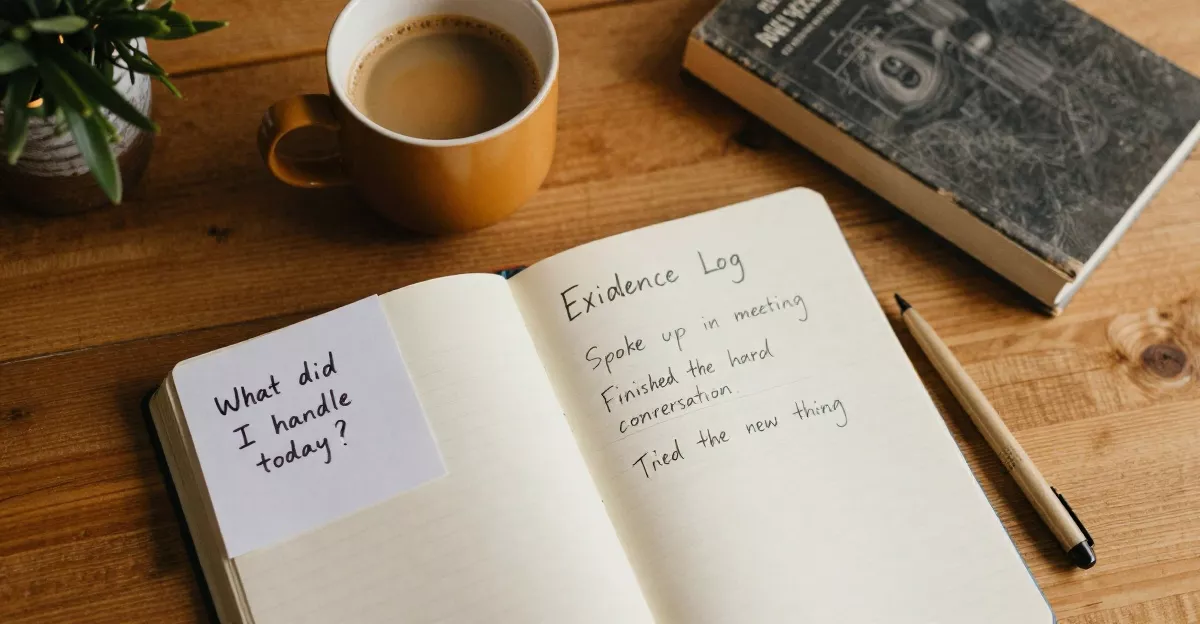
- Note the outcome in writing: what happened, what you handled, what you discovered about your capacity
- Repeat with progressively greater challenges as evidence accumulates
This is not motivational advice. It is Bandura's mastery experience protocol applied directly. The confidence that results is not manufactured. It is earned, evidence-based, and neurologically encoded.
Pillar 2: The Self-Compassion Foundation
Here is the finding that surprises most people when they first encounter it: self-compassion is a more effective foundation for genuine confidence than self-criticism - and this is not a soft, feel-good claim. It is one of the most robustly supported findings in contemporary psychological research.
The intuition that self-criticism drives performance - that being hard on yourself is the engine of improvement - is contradicted by decades of research. Chronic self-criticism activates the threat system: the same neurological response to external threat is triggered by internal self-attack, producing cortisol, anxiety, rumination, and the avoidance of challenges that might produce further self-criticism. The person who fears their own response to failure avoids the very situations that would generate the mastery experiences required for genuine confidence.
Self-compassion - treating yourself with the same basic decency you would extend to a friend in difficulty - deactivates the threat system and activates the self-compassion system (affiliative positive emotion, soothing, safety) instead. From this neurological state, the prefrontal cortex can process failure as information rather than condemnation, extract learning rather than producing shame, and return to engagement rather than retreat.
Dr. Kristin Neff at the University of Texas - the researcher most responsible for establishing self-compassion as a serious scientific construct - has produced consistent evidence across hundreds of studies showing that self-compassion predicts greater emotional resilience, lower anxiety and depression, higher motivation after failure, and - critically - higher genuine self-worth than self-esteem that is contingent on performance. The Positive Psychology research on building confidence through self-compassion practices confirms that people with higher self-compassion are more willing to acknowledge weaknesses and failures, more motivated to improve, and more resilient in the face of setbacks - precisely because they are not protecting a fragile self-image that requires defending.
The practical protocol:
- When you fail or perform below your standards, apply the three components of self-compassion: mindfulness (acknowledge the difficulty without exaggeration), common humanity (recognize this is part of the human experience, not evidence of unique inadequacy), and self-kindness (speak to yourself as you would speak to a friend)
- Write a self-compassion letter after significant failures or disappointments - the act of articulating understanding and kindness in writing has measurably stronger emotional processing effects than silent self-reassurance
Pillar 3: Strengths-Based Identity Architecture
Most confidence-building advice focuses on fixing weaknesses - addressing the gaps, improving the deficits, working on the areas of lowest performance. The research on genuine confidence building points in a different direction: confidence grows most reliably from the deliberate identification and deployment of genuine strengths.
As clinical psychologist Dr. Fallon's evidence-based framework on strength-based confidence strategies explains, neuroscience research has confirmed that repeatedly engaging core strengths strengthens positive neural networks - making it progressively easier to access confidence in challenging situations. A comprehensive meta-analysis confirmed that strength-based therapeutic interventions increase treatment efficacy and produce more sustainable positive outcomes than deficit-focused approaches.
The mechanism: when you operate from genuine strength, performance confirms your self-model rather than challenging it. Each successful deployment of a real strength builds the evidence base described in Pillar 1 - but does so in a domain where success is more probable, generating more frequent and more meaningful mastery experiences.
The practical protocol:
- Complete the VIA Character Strengths Survey (free at viacharacter.org) - the most widely used and validated strengths identification tool in positive psychology
- For 30 days, deliberately use your top 3 signature strengths in new ways - in work, in relationships, in challenges
- Maintain a Success Journal: 5 minutes each evening documenting three specific things you did well that day - not grandiose achievements, but genuine competent actions. Over weeks, this practice rewires the attention system away from its natural negativity bias and toward an accurate recognition of your own capability
Pillar 4: The Body - The Physical Dimension of Confidence
Confidence is not entirely a cognitive or emotional construct. It has a profound and often underestimated physical dimension - and the body-confidence relationship runs in both directions.
The well-documented relationship between physical posture and psychological state - established most compellingly by Amy Cuddy and subsequently refined by broader research - reflects a genuine neurological reality: your body is continuously feeding information to your brain about your state, and the brain's interpretation of that information influences confidence, willingness to take action, and stress reactivity. The evidence for large "power poses" as a confidence intervention is contested - but the evidence for physical state as a confidence mediator is robust and consistent.
More significant than posture, the confidence-physical health relationship operates through exercise. Regular aerobic exercise produces consistent improvements in self-efficacy, body image, and general self-confidence through multiple mechanisms: the direct evidence that your body can perform demands you place on it (mastery experiences applied to the physical domain), the neurochemical improvements in mood and anxiety that reduce the emotional interference with confident behavior, and the structural changes to the brain regions governing emotional regulation and self-perception that sustained exercise produces.
A 2025 PMC study on self-efficacy, self-esteem, and resilience building confirmed that physical health behaviors - including regular exercise and adequate sleep - are among the strongest independent predictors of both self-efficacy and self-esteem across diverse populations. The person who wants more confidence and is sleeping poorly and not exercising is trying to build the second floor before the foundation is laid.
The practical protocol:
- Establish a minimum viable exercise habit - even 20 minutes of walking four times per week - as a non-negotiable foundation
- Use physical challenges deliberately as confidence-building mastery experiences: run a 5K, complete a strength training program, learn a physical skill. The evidence of physical capability is among the most psychologically transferable evidence of general capability
The Confidence Destroyers: What to Stop Before You Start?
Understanding what builds confidence is only half the framework. The habits and patterns that systematically erode it are the other half - and most people are running both simultaneously, building with one hand and demolishing with the other.
Social comparison is the most pervasive confidence eroder in the modern world. The brain's social comparison mechanisms evolved to assess relative status in small, stable, face-to-face communities where comparison was informative. Social media has applied this mechanism to a curated, highlight-reel environment of hundreds of millions of people - producing comparison not against realistic peers but against the most successful, most attractive, most accomplished presentations of the most exceptional people globally. The inevitable result of comparing your ordinary Tuesday to someone else's exceptional moment is a confidence assessment that is systematically distorted toward inadequacy.
The research is unambiguous: social media use is negatively correlated with self-confidence, and the mechanism is primarily social comparison. The intervention is not complex: reduce the amount of time you spend in environments that make you compare yourself unfavorably to others, and deliberately redirect attention toward your own progress relative to your own past rather than relative to others' present.
Perfectionism deserves equal attention. The perfectionist's relationship with confidence is paradoxical: perfectionism is often a confidence-protecting strategy (if I never attempt things I might fail at, I will never generate evidence that I cannot do them) that is simultaneously confidence-destroying (without attempting challenging things, no mastery experience evidence is generated). The only path through perfectionism is the same path through every confidence-building challenge: graduated exposure to imperfect action, with self-compassion as the buffer against the self-criticism that perfectionism generates on contact with any suboptimal outcome.
Avoidance of discomfort is the final, most comprehensive confidence destroyer - and the one that all the others feed into. Confidence is built in discomfort. Not in the safety of familiar actions and predictable outcomes, but in the specific experience of doing something hard, uncomfortable, or uncertain - and discovering that you survived it, handled it, or learned from it. Every avoided discomfort is a missed mastery experience. Every mastery experience avoided is a piece of evidence withheld from the confidence file.
The uncomfortable thing is, in most cases, precisely the thing that needs to be done.
The Confidence Paradox - and How to Resolve It?
Here is the core paradox of confidence that most frameworks fail to address directly: you cannot think your way to confidence. You can only act your way there.
Confidence does not precede brave action. It follows it. The person waiting to feel confident before attempting the difficult conversation, the ambitious goal, the public presentation, the new skill - is waiting for a feeling that is not generated by waiting but by doing. The sequence is not: feel confident → take action. It is: take imperfect action → survive the discomfort → update the evidence base → feel slightly more capable → take the next action.
The actions do not need to be large. They need to be consistent and slightly outside the comfort boundary - small enough to attempt without requiring the confidence you are building, large enough to generate evidence when completed. The compound interest of this process across weeks and months is not merely incremental. Research consistently confirms that self-efficacy improvements are nonlinear - early mastery experiences are difficult and produce small gains, but as the evidence base builds and the self-model shifts, subsequent challenges require less effort and produce more confidence in return.
You do not need confidence to begin. You need the understanding that beginning is how confidence is built.
The Final Word: Confidence Is a Practice, Not a Destination
The most important reframe this article can offer is this: confidence is not a state you arrive at and then maintain. It is a practice you return to - daily, imperfectly, progressively.
There will be days when the evidence file feels thin. When a setback erases the accumulated progress of weeks. When a comparison moment or a significant failure temporarily dismantles the self-model you have been building. This is not evidence that the process is not working. It is evidence that you are operating at the edge of your comfort zone - exactly where confidence is built.
The unshakeable confidence the article's title promises is not immunity to doubt. It is a relationship with doubt that does not stop you. It is the deep, experience-based knowledge that you have faced hard things before and navigated them - imperfectly, with uncertainty, sometimes with help - and that this hard thing is no different.
That knowledge is available to everyone. It is built the same way by everyone who has it: one uncomfortable action at a time, across a long enough horizon that the compound interest of those actions becomes impossible to ignore.